


Coaching as experiential learning
Experiential learning makes an important contribution to coaching theory. Coaching literature highlights how coaching provides an opportunity to learn through experience. Indeed, the experiential learning model forms the foundation for coaching practice.
Many coaching models bear a striking resemblance to Kolb’s (1984) cycle of experiential learning (see figure below).
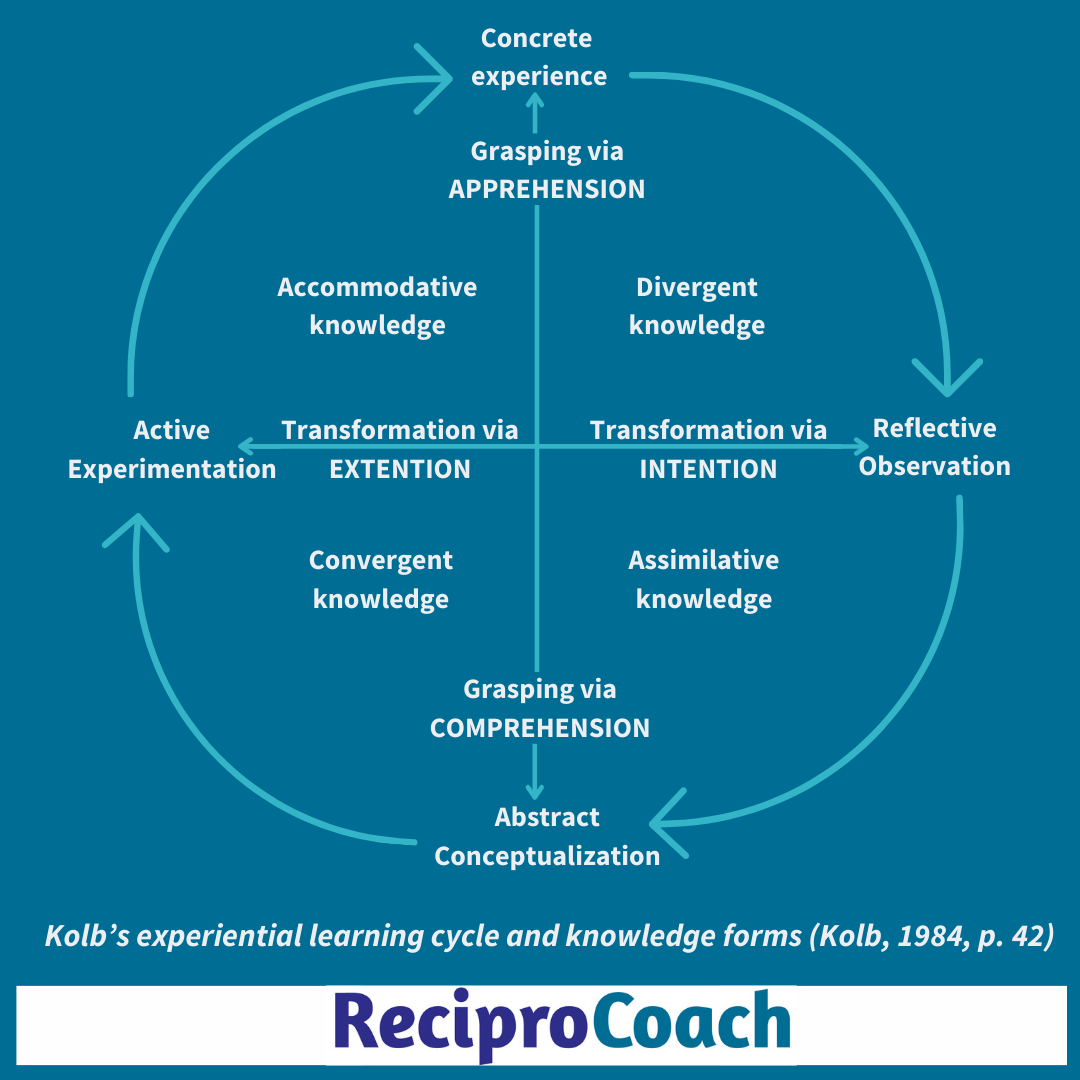
Kolb’s experiential learning cycle and knowledge forms (Kolb, 1984, p. 42)
Just as coaching often involves identifying a problem, setting a goal, taking action, and monitoring and evaluating progress, Kolb’s cycle of experiential learning involves concrete experience, reflective observation, abstract conceptualization and active experimentation in the process of knowledge creation.
Kolb’s experiential learning theory also includes a synthesis of adaptive processes, the foundations of which lie in scientific enquiry and problem-solving, decision-making and creative process. Kolb stipulated that “there may be great payoff in the integration of findings from these specialized areas into a single general adaptive model” (1984, p. 33). Indeed, it seems that coaching provides such integration – the coaching framework and processes are reflective of Kolb’s basic adaptive processes including:
- Problem Finding – Question Asking – Answer Seeking – Portrayal of Knowledge
- Exploration – Focusing – Grounding – Structuring – Investigation – Verification – Recording – Communication
- Incorporation – Incubation – Insight – Verification
- Intelligence – Design – Choice
- Choose a model or goal – Compare it with reality – Identify differences (problems) – Select a problem – Consider alternative solution – Evaluate consequences of solution – Select a solution – Execute a solution
- Concrete experience – Reflective observation – Abstract conceptualization – Active experimentation
Reflections of coaching are visible through Kolb’s adaptive model. Most notably, the problem and answer-seeking can be directly correlated with clients entering coaching with a need for change and using coaching to uncover and discover the answers that will bring about this change. These two points can be seen to act as “creative tension” (Hargrove, 1995, p. 90) in coaching, which pulls clients from their current realities toward their future visions. Then, between these two points, Kolb identified question asking, a dominant communicative coaching process and portrayal of knowledge, which in turn reflects the learning base clients progressively build. This is facilitated by processes like those explained within the goal-directed coaching framework. Finally, at the centre of the model is the coaching/learning cycle.
Reference:
Griffiths, K. (2008). Discovering, applying and integrating self-knowledge: A grounded theory study of learning in life coaching (Ph.D). Centre for Learning Innovation, Queensland University of Technology.
Hargrove, R. (1995). Masterful coaching: Extraordinary results by impacting people and the way they think and work together. San Francisco: Jossey-Bass.
Kolb, D. A. (1984). Experiential learning: Experience as the source of learning and development. Englewood Cliffs, NJ: Prentice-Hall.