


What is learning and why does it matter to coaching?
Learning may be viewed from the perspectives of various philosophical disciplines and schools of thought, and each has its own definition of what learning is and how it should be facilitated. In addition, there is a range of learning theories which explain specific kinds of learning that are appropriate to particular kinds of learners or that yield particular kinds of outcomes. Therefore, the task of identifying one definition of learning is difficult. Despite this, educational dictionaries appear to agree that:
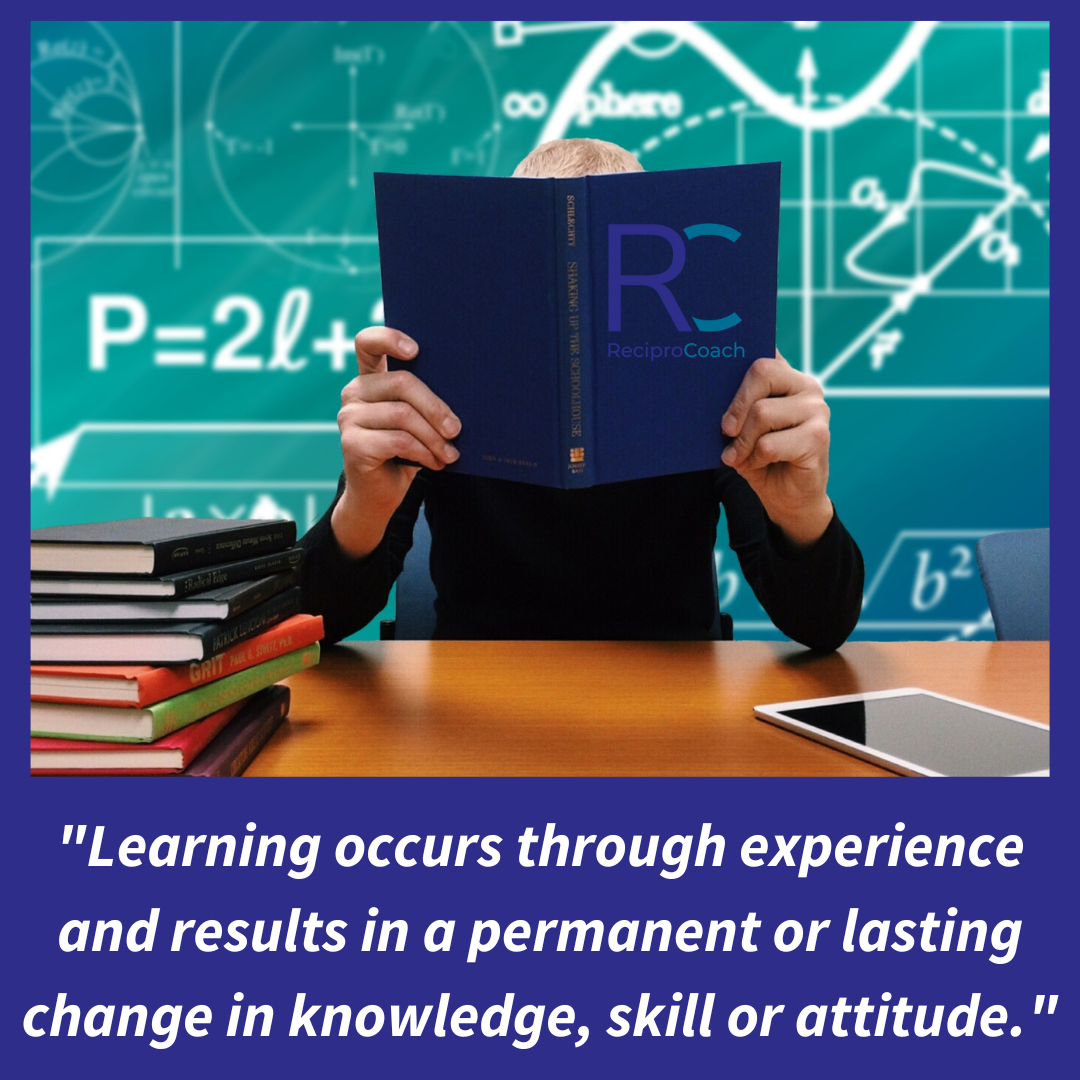
Learning is inherently recognised in the process of coaching in both prescriptive and evidence-based literature. Foundational prescriptive texts consistently identify the role of learning in the coaching process. Whitworth et al. (1998) explained that a major part in the coach’s job is to “deepen the learning” (p. 5), while the International Coach Federation (ICF) proposed the facilitation of “learning and results” as one of four major coaching processes. Furthermore, coaching has been described as “a vehicle and a platform for learning”, “a model for effective learning” and a “holistic multifaceted approach to learning and change”. It has featured in some empirical studies as a “forum for learning” and a “personal education pathway”. Similarly, in her phenomenological study of organisational coaching, Hurd (2004) stated that coaching “creat[es] the conditions for learning and behavioural change” (p. 41), depicting the coaching process as one of “learning for life” (p. 33). Thus, as Skiffington and Zeus (2003) suggested, it appears that “learning is at the heart of coaching” (p. 30), and it seems to be implicitly understood that in order to achieve coaching outcomes, learning must occur.
Reference:
Creane, V. E. (2002). An exploratory study of personal coaching from the client’s perspective. Unpublished doctoral dissertation, California Institute of Integral Studies, San Francisco.
Duff, P. J. J. (2002). The role of personal coaching in enhancing leadership confidence and learning capability. Unpublished masters dissertation, Royal Roads University.
Griffiths, K. (2005). Personal coaching: A model for effective learning. Journal of Learning Design, 1(2), 55-65.
Griffiths, K. (2008). Discovering, applying and integrating self-knowledge: A grounded theory study of learning in life coaching (Ph.D). Centre for Learning Innovation, Queensland University of Technology.
Hurd, J. L. (2004). Learning for life: An investigation into the effect of organzational coaching on individual lives. In I. F. Stein & L. A. Belsten (Eds.), Proceedings of the First ICF Coaching Research Symposium (pp. 33-42). Mooresville: Paw Print Press.
International Coach Federation. (1999). ICF professional coaching core competencies. Retrieved October 21, 2004, from http://www.coachfederation.org/credintialing/en/core.html
Lawton, D., & Gordon, P. (1996). Dictionary of education (2nd ed.). London: Hodder & Stoughton.
Rowntree, D. (1981). A dictionary of education. London: Harper and Row Publishers.
Whitmore, J. (2002). Coaching for performance (3rd ed.). London: Nicholas Brealey Publishing.
Whitworth, L., Kimsey-House, H., & Sandahl, P. (1998). Co-active coaching. California: Davies Blade Publishing.
Zeus, P., & Skiffington, S. (2002). The coaching at work toolkit: A complete guide to techniques and practices. Sydney: McGraw Hill.